Ready to make it happen
Contact Us
Insights

Revolving Door Syndrome: The Age of the Disposable Leader

29th September 2026

Back to News & Insights

This article was written by a Special Interest Group hosted by Skarbek, the following members contributed:-  Damely Akizhanova, Thorsten Böhle, Cédric Kahl, Holly Sanders, Paul Heugh

Something has gone wrong at the top of almost everything. Boardrooms, Whitehall departments, football clubs, political parties and large project teams increasingly share an unwelcome characteristic: their leaders are changed before their strategies have had time to work.

The evidence suggests this is more than an impression. In 2025, 234 chief executives of publicly listed companies left their posts globally, 16% more than in 2024 and 21% above the eight year average. The average tenure of departing CEOs fell to 7.1 years, from 8.3 years in 2021. More revealingly, CEO turnover is no longer confined to failing companies. Among S&P 500 companies in the top three performance quartiles, The Conference Board, Egon Zehnder and Semler Brossy found that CEO departures rose from 7% to 12% between 2024 and 2025, almost the same as the worst performers. Being good at the job is no longer protection against losing it.

Politics provides an even more visible example. Britain has had seven prime ministers since 2016. Beneath them sits a quieter rotation of the officials expected to provide continuity. Civil service turnover reached almost 12% in 2023, while turnover in some central departments was substantially higher: 21.8% in the Treasury and 20.5% in the Cabinet Office in 2023/24. The Institute for Government estimates that excessive civil service turnover costs up to £74m a year in recruitment, training and lost productivity, before accounting for the less visible costs of lost expertise and disrupted projects.

This is not simply bad luck. It represents a structural and societal change in how institutions and individuals relate to their leaders.

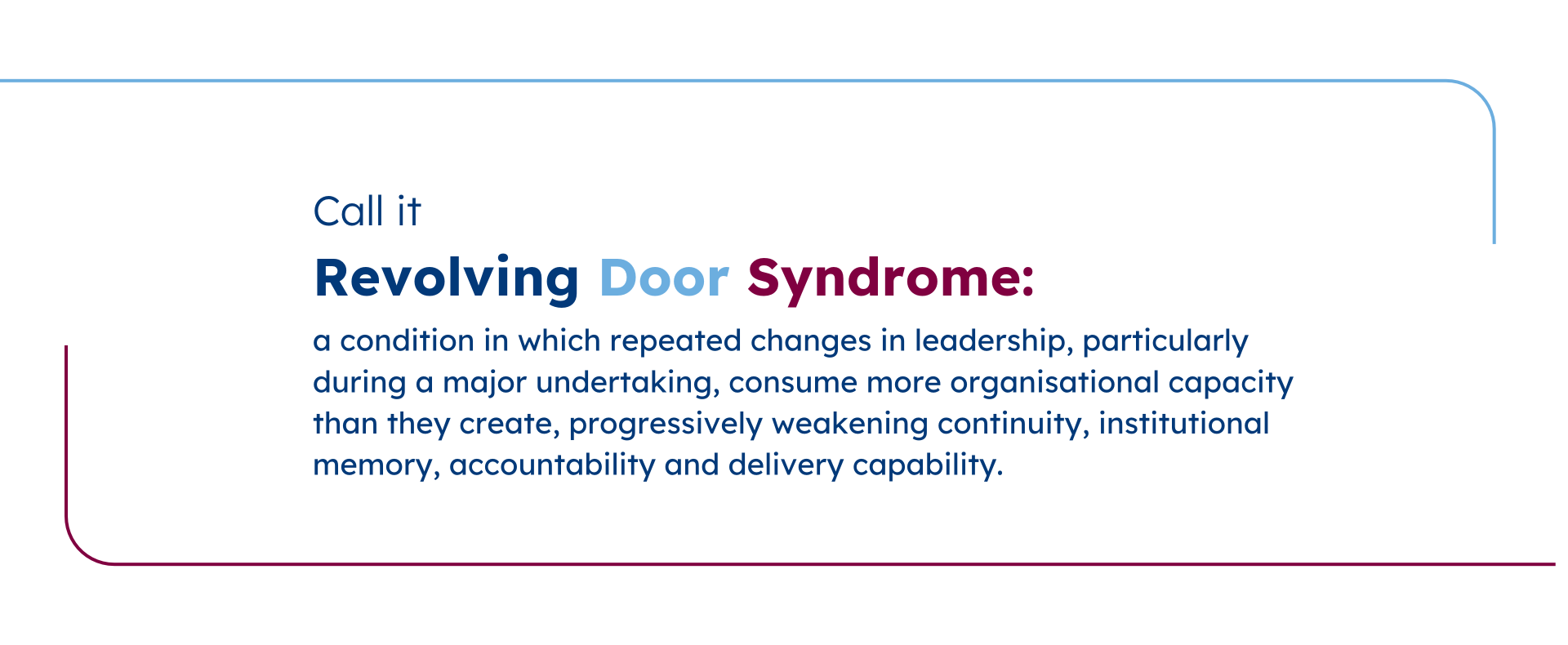
When does rotation become a syndrome?

Leadership rotation is not inherently harmful. A new leader can inject ideas, remove toxic leadership, reset culture, recover a programme or realign an organisation when circumstances demand it. The problem begins when the rate of change exceeds the organisation’s ability to absorb it and use as a force multiplier.

There is no universal stopwatch. A technology or pharma company may need a different leadership rhythm from a defence programme or a major infrastructure project. But repeated leadership cycles of less than 18 to 24 months should be treated as a warning sign, particularly during major transformation. At project level the test is simpler: if sponsors or programme leaders change faster than the project can absorb the transition, the organisation is accumulating disruption rather than leadership driven value.

The syndrome applies beyond CEOs. It can occur at board, executive, division, programme, project or functional level. Nor does every leadership change carry the same risk. An organisation with strong processes, distributed knowledge and disciplined governance can tolerate more rotation than one whose strategy and institutional memory reside principally in a few individuals.

The measure should therefore be neither tenure nor turnover alone. It is whether each successive change leaves the organisation more or less capable of delivering its purpose.

Why is it happening?

No single cause explains every leadership change. Turnover can be a response to failing performance, rather than its cause. But several forces increasingly reinforce one another and make continuity harder to preserve.

First is impatience and compressed accountability. Boards, shareholders and electorates increasingly expect visible momentum in much shorter periods. Investor activism, continuous media scrutiny and more demanding performance expectations narrow the time leaders must demonstrate impact. In 2025, 32 CEOs resigned within a year of an activist campaign; globally, departures within the 30 – 36 month window rose 79% year on year. The pressure is particularly acute when performance is judged quarterly or politically over a few months. This is not necessarily evidence of poor governance. Decisive intervention can be justified, but it does make long-term execution harder to protect.

Second is complexity with shorter horizons. Leaders are expected to address technological disruption, geopolitical and regulatory volatility, supply-chain exposure and changing stakeholder expectations simultaneously. Those pressures make strategic review necessary. The danger comes when review becomes automatic reset. Uncertainty is treated as evidence that the leader, structure or strategy must be replaced before the organisation has learned whether the existing response can work.

Third is an institutionalisation gap. In many organisations, the formal handover transfers milestones, budgets and organisation charts, but not the reasoning behind earlier decisions: the assumptions made, alternatives rejected, commitments given and risks consciously accepted. Strategy then remains attached to relationships and individual memory. When the leader leaves, the successor inherits facts without context and reopening decisions becomes understandable, even if it is costly.

Switzerland offers a useful contrast. Its government is not static: the presidency changes annually and Federal Councillors can resign. Yet a change of president does not represent a change of government. Executive authority rests with a seven-member Federal Council, whose members have equal standing; decisions are made collectively and consensus is actively sought. The President is primus inter pares chair, rather than a dominant executive.

This design separates visible leadership rotation from strategic discontinuity. A new annual president does not arrive with a new cabinet, mandate or automatic need to repudiate a predecessor’s decisions. The system has costs: consensus can be slow and difficult reform can take longer. But the principle is transferable. Continuity does not require one indispensable leader; it can be designed through shared decision-making, clear processes and collective ownership of decisions.

This can become self-reinforcing. New leaders are expected to show impact quickly and establish a mandate. A fresh structure, a new set of priorities, or a hundred-day plan offers the visible theatre of action. The incentive is often structural, not personal: research on CEO tenure suggests that leaders in their early years face especially strong pressure to signal competence through short-term decisions. The danger begins when differentiation matters more than judgement. Organisations then reward mobility over mastery, advancing people who move between roles rather than those who stay long enough to build deep expertise and see difficult initiatives through. The result is a peculiar form of organisational amnesia.

The result is a paradox. Organisations respond to uncertainty by changing leaders and direction more frequently; repeated resets then reduce the very learning, trust and execution capacity needed to deal with uncertainty.

The cost of the carousel

The immediate cost is transition. Revolving doors at the top often set off a chain reaction, with change rapidly becoming change cubed. Teams must explain the past, reinterpret priorities, rebuild relationships and adapt to new expectations before the previous round has settled.

Resilience is not instantaneous. People need time to understand why something is changing, what it means for them, to develop capability, practise new behaviours and receive feedback. Without reflection and assimilation, change becomes not renewal, but cumulative fatigue.

The economic consequences can be severe. Imagine an acquisition driven by a leader’s short term incentives, with due diligence rushed because the transaction is expected to demonstrate rapid growth. The leader subsequently leaves. The successor inherits an acquisition that destroys value and a workforce that must absorb the consequences. The failure may appear to be an acquisition problem. In reality, it may be a leadership continuity problem.

the costs

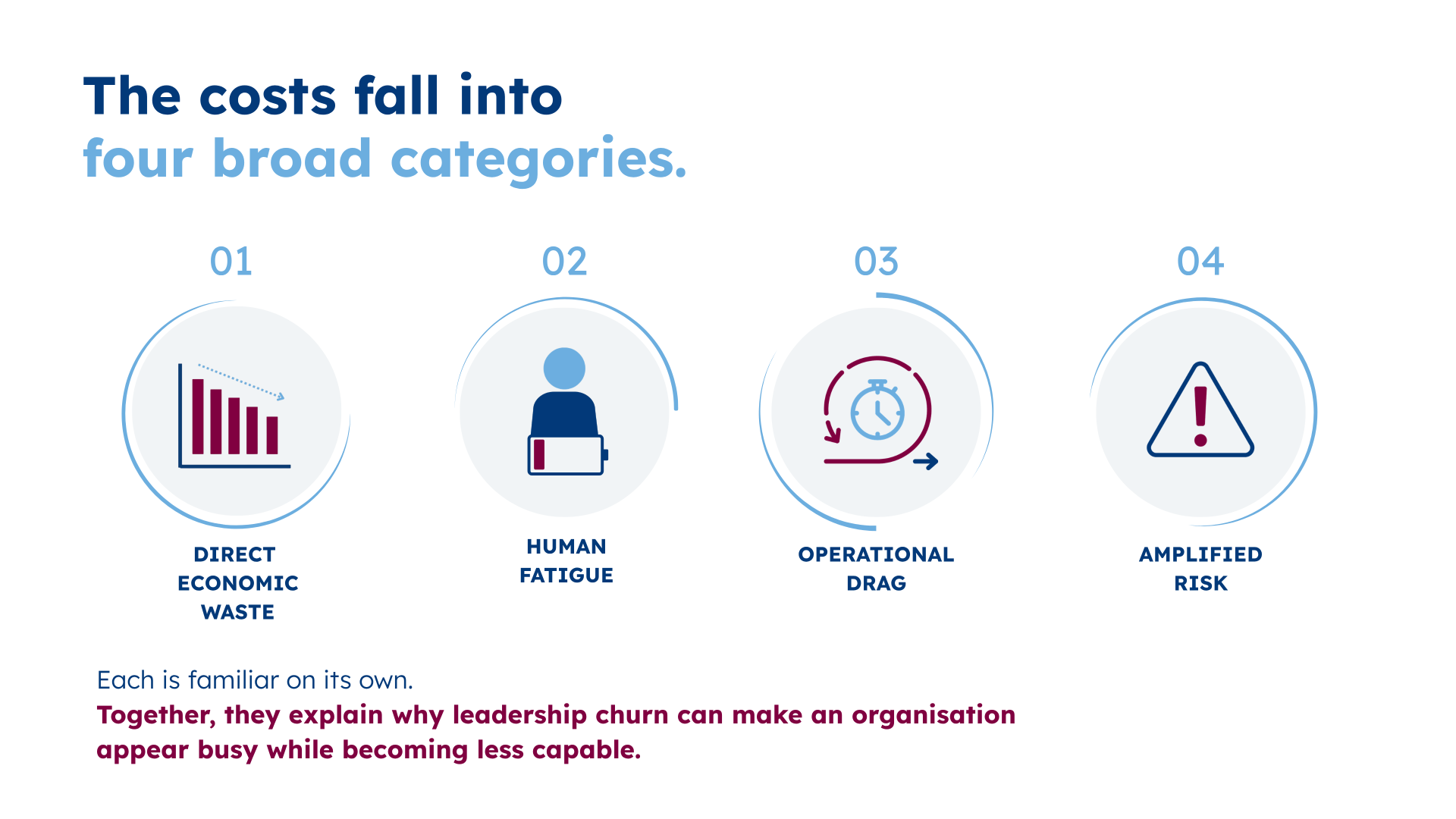
The most visible cost is economic.

New leaders revisit earlier choices, reopen settled questions and duplicate effort that has already been paid for. Approvals slow as decision-making machinery pauses for re-briefing, while the expected strategic benefits of an initiative erode when its logic, assumptions, priorities and commitments are repeatedly put back on trial. Failed acquisitions are an extreme version of the same pathology: rushed due diligence, often driven by short-term individual incentives, may deliver a brief impression of growth before leaving the successor to absorb the loss. This risk is amplified when leaders behave as mercenaries, prioritising rapid career moves and higher compensation over organisational continuity, and departing before the consequences materialise.

The hidden human costs are less easily accounted for, but often more damaging.

Teams must absorb new expectations, rebuild context and carry the extra workload created by transition. Energy and morale drain away as resets become routine. Stakeholder relationships fragment; trust thins; psychological safety weakens as people become reluctant to commit, challenge or speak plainly when direction may change again. The result is cognitive congestion: attention that should be spent on execution is instead spent on orientation.

Operationally, churn creates drag.

Milestones slip when leadership changes interrupt decisions. Governance becomes unstable as committees and boards lose continuity, and processes are often reinvented before the previous version has had time to work. External shocks also become harder to absorb as internal risks, knowledge gaps, misalignment and delayed decisions, grow with each handover.

At programme level the pattern is familiar. A new sponsor reopens decisions, alters priorities or changes the definition of success. None of this is necessarily irrational. Repeated often enough, however, it turns leadership into overhead: consuming management capacity, weakening confidence and delaying delivery.

Resilience rather than resistance

The answer is not to stop changing leaders. It is to design organisations that can absorb leadership change without repeatedly starting again.

That requires more than succession planning. It requires change capability: common methods for managing transformation, disciplined communication, opportunities to discuss and challenge change, feedback mechanisms, adequate training and sufficient time for new behaviours to become established.

It also requires deliberately distributing knowledge. Subject matter experts matter because they understand how change interacts with processes, technology and human behaviour. Their role is not to prevent change but to make it executable.

The military provides a useful analogy. Armed forces are designed to continue functioning when sub-units are destroyed, when leaders are killed, wounded or removed. Personnel are trained to understand the responsibilities of those above them and to operate at a higher level when necessary. Organisational knowledge is deliberately disseminated through doctrine, process, training, mindset and after-action reviews rather than being allowed to reside exclusively in individual heads.

Most businesses are considerably less resilient. When a senior executive leaves, they often discover that strategy, relationships and knowledge were less institutional than they thought.

From disposable leaders to resilient institutions

The age of the disposable leader may be upon us. The lesson is not that leaders should be left in place indefinitely, nor that organisations should resist necessary change. It is that leadership rotation must be treated as a form of organisational stress, to be designed for rather than merely endured.

Boards should distinguish between rotation that refreshes an institution and rotation that destabilises it. Major programmes should treat leadership continuity as a delivery risk. Succession should begin years rather than months before departure. Knowledge should be deliberately distributed, and change programmes should give people time to understand, practise and embed new ways of working.

Above all, organisations should measure the capacity consumed by change. Every new leader, restructure or strategic reset carries a transition cost. Sometimes the return is worth it. Sometimes the exercise merely substitutes motion for progress.

Artificial intelligence may help organisations see the problem earlier. Network analysis could show where critical knowledge and relationships are concentrated; AI could help detect the risks created when key people depart. But technology cannot solve the underlying human problem. People still need time to make sense of change and acquire the confidence to operate within it.

The revolving door may be unavoidable. The task is to stop it becoming a centrifuge: spinning out memory, trust and execution capacity each time a leader leaves.

The ultimate test is therefore simple: does each change leave the organisation more capable than before, or merely different?

In the next article on Revolving Door Syndrome, we will examine techniques for making change more intelligent, more data-driven and far less risky.

References

Message