
Ready to make it happen
Contact Us
Insights

Using AI to Boost Innovation on an Outdated Operating Model is like Fitting a Jet Engine to a Horse Cart

1st June 2026

Back to News & Insights

Clients come to us when innovation is stuck, and increasingly when they want AI to fix it. AI amplifies what is already there, for better or worse. The problem is rarely AI. Underneath, the operating model is slow, rigid, and quietly punishes experimentation. Asking ‘where can AI help us go faster?’ is usually the wrong starting question. AI will just help you do the wrong things faster, or expose existing frictions more acutely.

A client wants AI to transform commercial impact, but when you peel back the layers, the decisions in question belong to everyone and no one, trapped in a structure built for stability, not speed. Even with perfect AI, who exactly would act and when? Focusing on such fundamentals as accountabilities, decision rights and data readiness is the route to AI impact.
 

We believe AI reshapes the innovation operating model in two fundamental ways

AI as force multiplier

Where the innovation operating model is already functioning well, AI strengthens it by reducing administrative burden, accelerating insight generation, improving portfolio visibility, and enabling faster decisions. Equally, weak governance, unclear decision rights and bloated processes don’t disappear under AI, they scale. The trap is treating AI as a performance layer, when what’s actually needed is redesign.

AI as operating model in its own right

As organisations scale AI, it stops being a tool embedded in the existing innovation model and becomes a model layer of its own, requiring dedicated governance, ownership, guardrails, capability development, and value management. The trap is treating this as an IT, or tooling problem. Organisations that skip this layer accumulate AI capability without accountability, and value leaks.

Skarbek are strategy execution specialists focused on helping companies actually deliver their growth plans. When working with our clients, we usually start somewhere less glamorous than algorithms, but far more impactful: the operating model itself. Time and again, the biggest barrier to breakthrough results isn’t a lack of tools or ideas, but the way an organisation is set up to execute. Skarbek diagnoses precisely where the operating model is getting in the way. The diagnosis matters a lot here: is it structure, process, incentives, culture, capabilities, resources, or all of the above? Our diagnostic is ruthlessly honest about whether the organisation is capable of using what AI would unlock. From there, we don’t just advise. We partner with our clients to implement the operating model required to make that engine work.

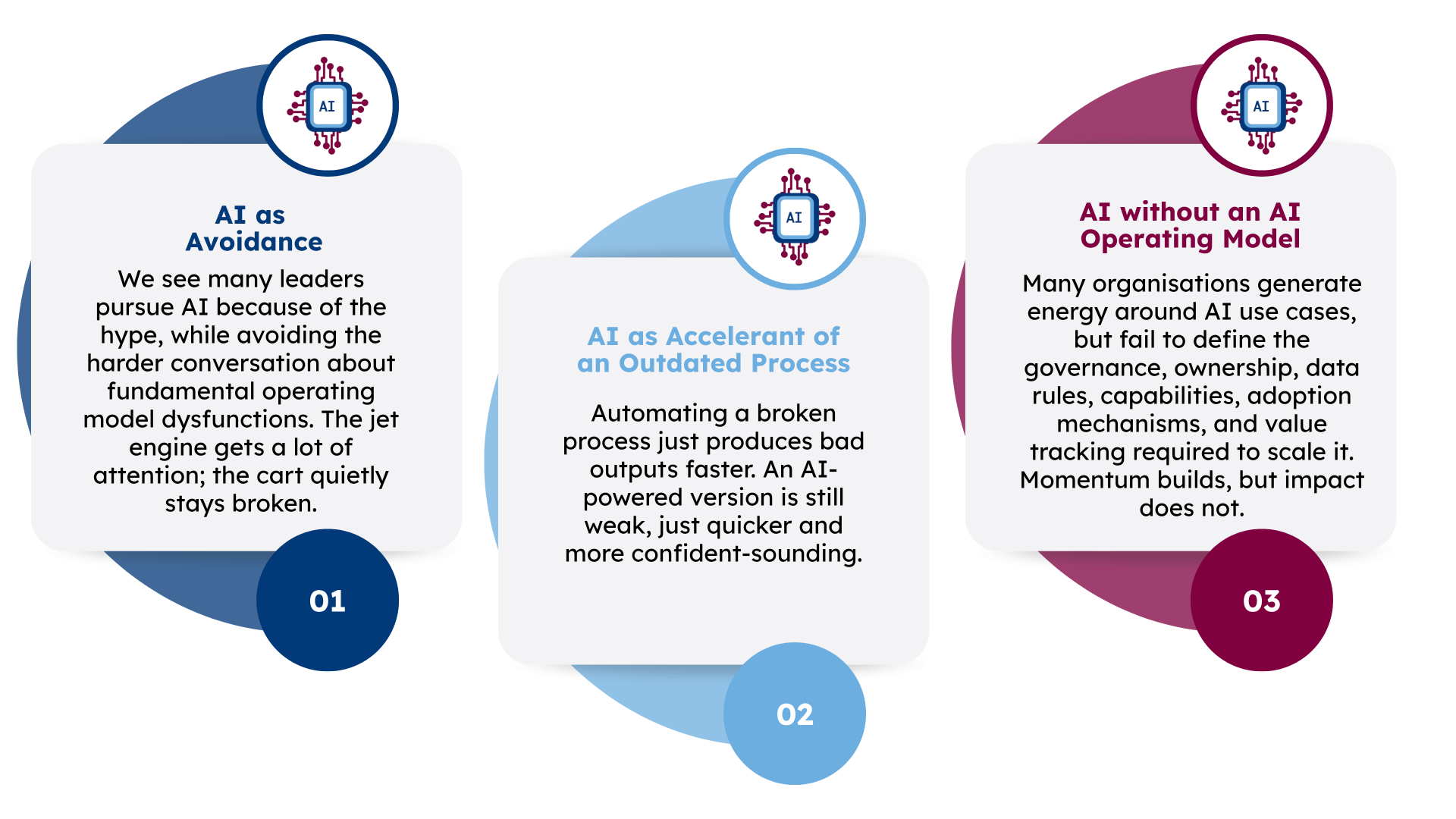
Across sectors, we see organisations fall into three predictable traps:


AI Traps


The Skarbek Approach to Integrate AI into the Operating Model

So, what is the one thing a CEO should do on Monday morning?

Before asking for another list of AI use cases, pick one strategically important innovation opportunity and run a simple operating model stress test around it. 

Ask your leadership team four questions: 

  1. What decision needs to be made to move this opportunity forward? 

  2. Who has the authority to make that decision? 

  3. What data, insight, or AI output would help them decide better or faster? 

  4. Once the answer is available, who has the mandate, resources and accountability to act upon it? 

If the team cannot answer these questions clearly, the bottleneck is not AI. It is the operating model. Fix that bottleneck and AI has something powerful to accelerate. Ignore it, and you are simply fitting a jet engine to a horse cart. 


Joia Spooner-Fleming
Message